
Shawn Childs · in his own words, unedited
2026 Circa World Championship Draft Results and Recap
By Shawn Childs · updated September 3, 2026

The high-stakes fantasy football market reached new heights on August 28th when Circa Resort & Casino hosted a live draft at the famous Stadium Swim. Twelve daring and deep-pocket game managers ponied up $100,000 to compete for $1.15 million in prize money.
World Championship $100K Legacy League — Prize Structure
1st Place: $600,000
2nd Place: $250,000
3rd Place: $200,000
4th Place: $100,000 (money back)
Each team in this contest bid part of their $1,000 free-agent budget for their choice of draft spot. The winning bidder claims their draft slot of choice. The Circa World Championship features a third-round reversal for their draft order, giving the first pick in round 3 to team 12 instead of the traditional team 1. The back end of this format is much better, especially for the teams that draft wide receiver-heavy early.
Here’s a look at the owners, draft order, and bids:
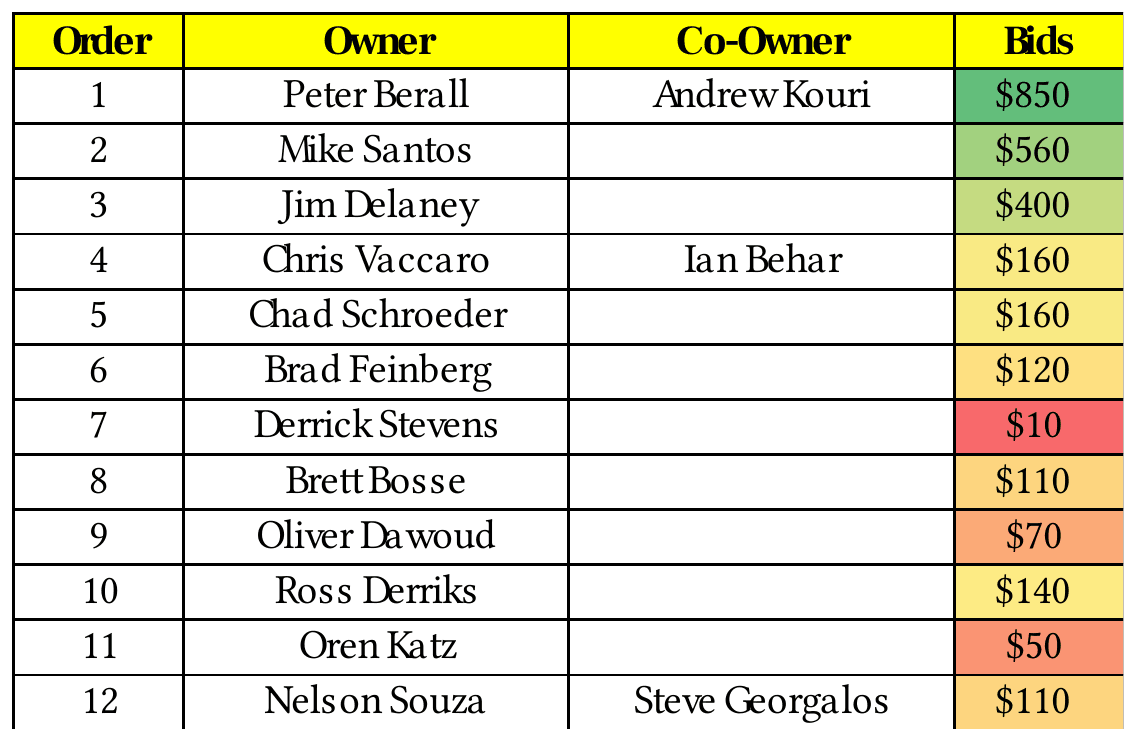
For anyone asking how someone could pay $850 for the first pick, it takes two to tango in the bidding. Based on the results, three teams were willing to fight for a top-three draft pick. The difference between Jahmyr Gibbs and Bijan Robinson is a lot closer than $290 in free-agent dollars. Sometimes, at these types of events, there is some gamesmanship in bidding up another owner. Once the top three draft slots were claimed, no one else was willing to put up a significant bid for any other draft slot.
Jahmyr Gibbs or Bust
As for team one, and I mentioned this in my draft recap video, many years ago, I ran some home leagues where each team could only pick up three players each week. Between a team’s bench options and these minimal moves, a game manager still has plenty of chances to manage their waiver wire moves. This approach requires looking ahead and staying healthy. In most FAAB leagues, the free agent player pool doesn’t support $12,000 in player inventory, leading to many wasted overbids and some teams wondering why they didn’t tee it up when given the chance earlier in the year.
Team 1
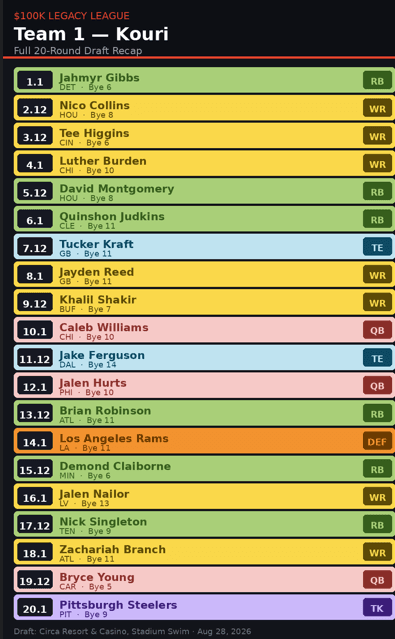
The edge with Jahmyr Gibbs is clear, but his top three foundation at wide receiver has a fine line between elite ceiling and injury risk. Each option brings big-play and scoring upside. Luther Burden brings a winning feel, but he comes into 2026 nicked up.
His combination of quarterbacks and tight ends may lead to some challenging decisions and possible mistakes in the biggest moments of the year.
David Montgomery and Quinshon Judkins lack a high pass-catching floor, requiring both players to score up their consistency factor.
Team 1’s flex option hinges on the floor of Jayden Reed, who should be worth a minimum of WR36 status with a full season of games. His outcomes can get dull at times, inviting game managers to overmanage him if Christian Watson, Matthew Golden, and Tucker Kraft out-target him over multiple games. The rest of his wide receiver options have a 10.00 PPR ceiling over the long haul.
Both Demond Claiborne and Nicholas Singleton fit the upside backup running back price tag. I’ve shoved on Singleton this year, so I’m biased on his ceiling and potential.
This team should gain some fantasy points from the Rams’ defense.
Outlook: I sense an injury or two could derail this team due to minimal help off the waiver wire. Ultimately, does this team have enough depth at RB and WR to be competitive during key bye weeks?
Team 2
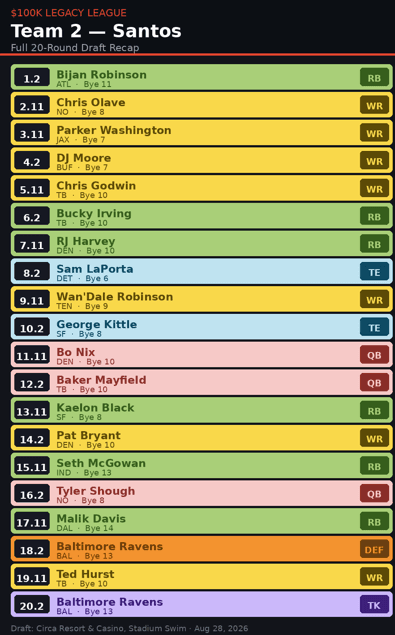
At the end of the year, Team 2 should reflect on their draft and wish they made a couple of better decisions. First, I could never select Kaelon Black over my handcuff to Bijan Robinson. I understand the chase for more upside at RB4, but he’s not a lock to be the 49ers’ RB2, with questionable value in the passing game. If Christian McCaffrey has an injury, San Francisco will certainly rotate in two backs, creating a low-ceiling opportunity, in my opinion.
Today, I wrote an article about the sliding value of Patrick Mahomes. I don’t consider Baker Mayfield in the same realm as Mahomes, and he has the same bye week as Bo Nix. Mayfield has one impact season on his NFL resume, and Mahomes is a Hall of Fame quarterback who is motivated to get back to the Super Bowl.
I don’t expect Pat Bryant, Seth McGowan, Malik Davis, or Ted Hurst to survive the year on this roster.
On the positive side, his top three running backs are comparable to Team 1 while offering a potential edge in consistency due to their pass-catching.
The combination of Chris Olave, Parker Washington, DJ Moore, and Chris Godwin fits the yellow sticker, but Washington must reach WR2 fantasy status to break par for his price point. This team of drafters has a long resume of success, and they believe the Jaguars’ rising wideout has a higher ceiling. Moore moved to a top offense, and Godwin should offer a consistency factor, with a recent history of lower scoring. Maybe the drive for Baker Mayfield was tied to the drafting of Tampa’s WR2. Wan’Dale Robinson gives bye-week support, with a developing catch profile but on a lower-tier offense.
The combination of Sam LaPorta and George Kittle helps cover bye weeks at the flex position.
With $450 in FAAB, Team 2 will have enough wiggle room to improve their running back depth. I expect the Malik Davis over Nick Singleton decision to shift some added value back to Team 1.
Team 3
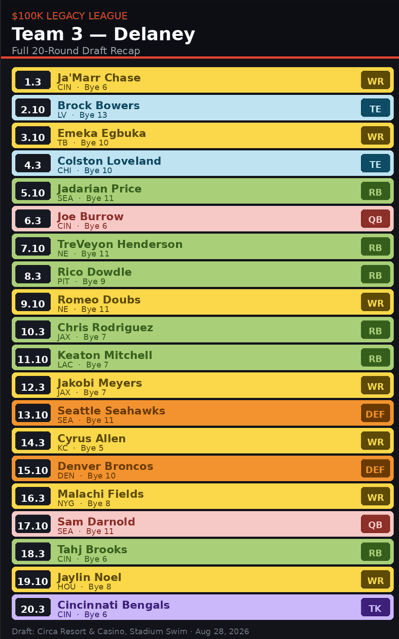
After seven rounds, Team 3 put together an intriguing combination of talent at quarterback, running back, wide receiver, and tight end. Burrow to Chase fits into the all-time great category, and the Bengals’ offense stays healthy all year. Brock Bowers is a clear edge, while Emeka Egbuka, Colston Loveland, Jadarian Price, and TreVeyon Henderson check the upside boxes. On the downside, Egbuka and Henderson come into the year nicked up.
From rounds 8 to 10, Team 3’s starting lineup could be slightly stronger with a different RB/WR combination. All three players selected offer a steady feel. Jakobi Meyers offers rotational WR3 value.
The backend of his wide receiver options project to be below replacement value to cover bye weeks, at least out of the gate. Team 3 wants to gain an edge at the defense position. His RB4 and RB5 options offer minimal playable value until an injury emerges in the Chargers' and Bengals’ offenses.
This roster is closer to competing than the backend of his roster looks, if Team 3 can land a trusted WR3 and Price and Henderson finish with top-18 running back outcomes. Covering injuries and bye weeks could be an issue at the running back position.
Team 4
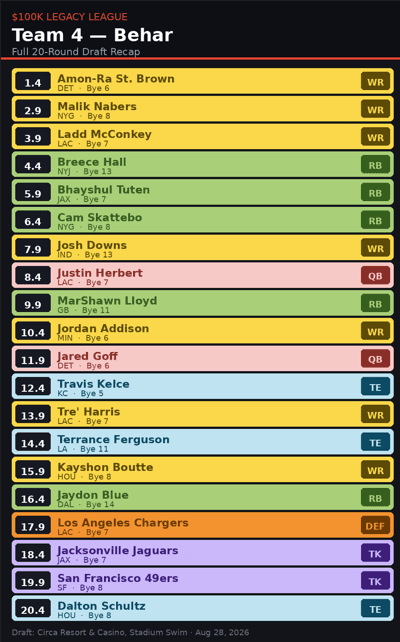
Team 4 teed up and placed his bet that Malik Nabers will be fine in 2026 and will regain his rookie form. The hope is that his best play comes late in the year. Amon-Ra St. Brown has a proven floor, while Ladd McConkey backed up this year. This drafter is a fan of the Chargers’ passing game, highlighted by selecting Justin Herbert as the QB5 off the board. LA matches up with SF, @MIA, and KC from Weeks 15 to 17.
He also added Tre’ Harris for upside and handcuff value to McConkey. Josh Downs and Jordan Addison should bridge this team through bye weeks and some minor injuries, with both players having different skill sets (volume with low scoring compared to big play/touchdowns). Kayshon Boutte should also help this roster once his role is established in Houston.
The Greenwich Street Tavern team had a homer feel by landing two New York starting running backs – Breece Hall and Cam Skattebo. I love the ceiling of Hall if the Jets’ offense gets better and the Jets’ coaching staff pumps the brakes on rotating in two other running backs. Two weeks ago, Skattebo seemed like a safer RB2 selection. The addition of Najee Harris will eat into his touches and possible scoring chances. In addition, Jaxson Dart is active rushing the ball, especially at the goal line. Based on potential, this team should break par at RB1 and RB2 if both players stay healthy, but both players do have some injury risk (Hall was nicked in many weeks last year, and Skattebo is coming off an injury).
As for Bhayshul Tuten, he checks the explosive box, and his overall opportunity should be better in 2026. His pass-catching floor seems low, and Chris Rodriguez will be a thorn at the goal line. Team 4 gave the Josh Jacobs team plenty of rope to handcuff him. The ninth round seems reasonable based on the news after the draft. His role/opportunity took a hit when Green Bay added Kaleb Johnson. MarShawn Lloyd has a lot of fantasy love out there in August, but his results on the field and health will drive his playable fantasy value.
Travis Kelce gives Team 4 a competitive target option at tight end, followed by a developing Terrance Ferguson who will compete with three other tight ends in Los Angeles for snaps and targets. Dalton Schultz comes off a good year, and he could turn out to be a more usable TE2 on this team over the long haul.
This drafter took the free look with the 49ers kicker while adding the booming leg of Cam Little.
Team 4 came out of the draft with an intriguing combination of players at QB, RB, WR, and TE, with his one weakness being running back depth. I expect him to be very interested in Kaleb Johnson in the first waiver. It makes sense for him to protect his Lloyd investment, and Jaydon Blue is a clear-cut option. A contending team that relies on these three players having good seasons: Nabers, Hall, and Skattebo.
Team 5
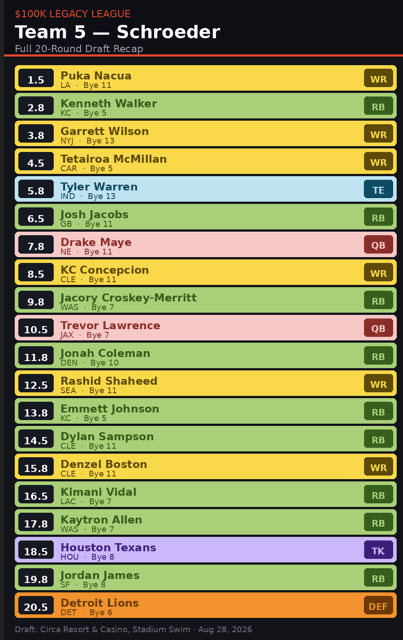
Mr. Schroeder takes on all comers in many sites in fantasy football. His volume of teams drafted and managed each season is impressive, but it brings a massive workload on the waiver wire. His winning success is legendary, and his script is readable, but his decision-making separates him from the field. His value portfolio team builds cover many combinations on draft day, complemented by winning lineup decisions and a sharp feel for free-agent bidding.
With $100,000 on the line, Puka Nacua has more risk than his great 2025 season shows due to him having a minor injury in August and a possible suspension looming. In addition, he’s playing on a minimal contract while needing to improve his off-the-field decision-making. If the Rams don’t pay him before the season, his motivation off an injury later in the year could be less. In the end, Nacua is a great player and a massive fantasy advantage when on the field. Are we playing to win? Or just trying to make the playoffs?
Kenneth Walker has been battling an ankle issue in August that should be minor. His price point was discounted, but his new opportunity suggests a higher ceiling in 2026.
Team 5 secured two talented wide receivers (Garrett Wilson and Tetairoa McMillan) in rounds 3 and 4, followed by a foundation tight end (Tyler Warren). His two wideouts play with below-league-average passers, which could lower their ceiling.
Unfortunately, he brought Josh Jacobs at a discount despite plenty of news to wait for a better update on his situation. The NFL commissioner dropped the exempt list ball on him about 24 hours later, leaving the fantasy market wondering if Jacobs will play this year or even again in his career. For a $100,000 entry fee, the pick had clear risk from the cheap seats in the bleachers.
In the seventh round, Team 5 secures a top-tier quarterback (Drake Maye) with a second viable top-10 option (Trevor Lawrence) three rounds later. If Jacobs only missed four games and Nacua plays 17 games, Chad has one of the better team structures in this draft after seven rounds, meaning a dance in the playoffs looks promising.
I’m neutral on KC Concepcion, while having no fight in me to draft Jacory Croskey-Merritt due to respecting the potential of Kaytron Allen to steal the early-down role for Washington. He secured his handcuff in round 17, giving Team 5 at least a viable RB2 out of the gate. Looking back at the draft in round 9, MarShawn Lloyd as a handcuff to Jacobs seems like an easy pick over Croskey-Merritt, but Schroeder may not be a fan of him due to his previous injury risk. Either way, Kaleb Johnson is only a phone call away.
For those who don’t follow the high-stakes market, the final 10 rounds of Team 5’s draft should give a hint of how the best play the game. The ideal team build starts with a foundation, impact, three-down running back, followed by a string of must-start/no-decision wide receivers. Look for top-tier value at quarterback and tight end while fading the RB2 position. The back end of the draft becomes a stampede of running backs, highlighted by rostering some of the best running back handcuffs. The goal is for their lineup to be the best late in the year when championships are on the line.
Team 5 left the draft with nine running backs. He handcuffed Walker with Emmett Johnson. He picked on the injury risk of J.K. Dobbins by adding the ceiling of Jonah Coleman. His draft ended with the handcuff to Quinshon Judkins, Christian McCaffrey (maybe), and Omarion Hampton. He’ll churn the backend of the running back pool while waiting for another drafter to drop a player of interest in a bye-week roster squeeze.
Rashid Shaheed brings big-play ability, but he could be challenging to time. Denzel Boston is almost a handcuff wide receiver in case Concepcion doesn’t hit the ground running.
Despite the speed bump of Jacobs, I expect Team 5 to be in the postseason if Puka Nacua doesn’t miss many games. His team has one tight end, so an injury to Tyler Warren would be a significant loss to his starting lineup.
Team 6
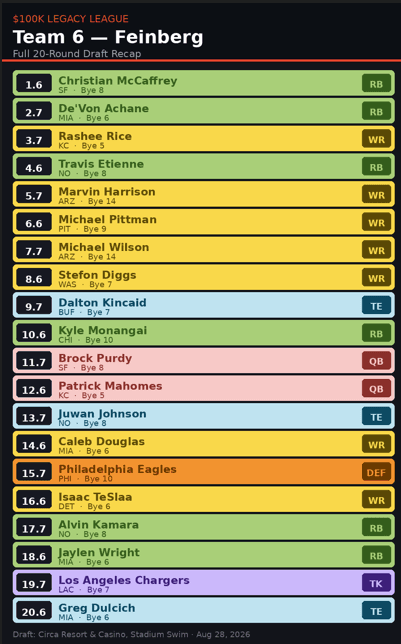
The front of Team 6’s draft checks the winning edge boxes at running back and wide receiver, but a healthy season of Christian McCaffrey is a must. He is a stud of studs who commands the ball and drives the 49ers offense. In one easy season, McCaffrey went from fantasy team wrecker to the best fantasy edge in the game.
De’Von Achane fits the high-floor, pass-catching mode at the running back position, offering an excellent consistency factor. On the downside, a new running quarterback points to fewer balls in the air in Miami and most likely less scoring. Travis Etienne should be getting more shine in drafts due to the Alvin Kamara injury. The Saints’ offense should flow between him and Chris Olave on many plays in 2026.
For me, Rashee Rice has a circle around his name in the third round. He has the ceiling for a 100-catch wideout with double-digit scoring and plenty of yards, and this drafter also paired him with the discounted, overlooked Patrick Mahomes.
Team 6 tied up both of the Arizona Cardinals' top two wide receivers (Marvin Harrison and Michael Wilson), with the hopes that one delivers WR2 fantasy outcomes for the year. Wilson's success last year will command the ball, especially with Jacoby Brissett behind center. Both players have a chance to rank in the top 36 at wide receiver, but it would require Arizona to throw the ball well over 600 times. For fantasy teams, a better outcome would be one player ranking as a mid-tier WR2 and the other falling more into a flex-start range.
Michael Pittman and Stefon Diggs have proven resumes, suggesting fantasy starts at wide receiver, helping Team 6 negotiate bye week and maybe some injuries.
This drafter took a swing on backing up two of his first three running backs, while adding a rotational option with Kyle Monangai in the 10th round.
His quarterback options (Brock Purdy and Patrick Mahomes) ranked in the top 5 in average fantasy points per game in most scoring formats, but much lower in season-total standings due to injuries.
Team 6 would love Dalton Kincaid to be on the field for more snaps and avoid injuries to take full advantage of his upside potential. His rookie 73-catch season remains in his rearview mirror, while showing an uptick in scoring and big plays in 2025. Juwan Johnson comes off a career season, and he appears to be a top-three option in the Saints’ passing game. I could see some lineup mistakes coin-flipping these two players unless Kincaid has a breakout season, something that would have happened last year.
Isaac TeSlaa brings scoring ability, but his summer reports didn’t come in as originally expected, leading to him sliding in drafts. Caleb Douglas fits the upside swing category, and some wide receiver needs to be relevant in Miami this year.
There’s a lot to like about this team's build, but any injury to Christian McCaffrey will leave a 20+ fantasy hole in Team 6’s lineup weekly. He had depth at QB, RB, WR, and TE, which will come with some testy decision-making over the long haul. I view Team 6 as a top-4 roster coming out of the draft.
Team 7
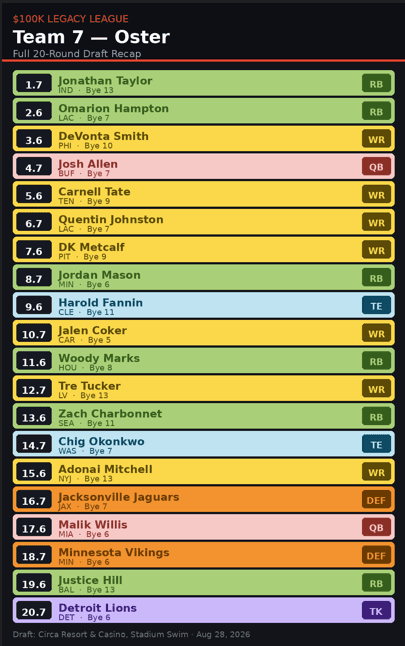
Team 7 went with an old-school roster-development approach that comes from selecting two foundation running backs (Jonathan Taylor and Omarion Hampton) and a stud edge at quarterback in round 4. In the 2026 high-stakes draft season, the quarterback position is discounted with competitive depth, inviting the question of how much more Josh Allen is over the rest of the quarterback field.
This drafter made good wide receiver draft decisions, but his structure is lacking an elite WR1, which is expected given his choice to gain edges at quarterback and running back.
DeVonta Smith has a proven WR2 resume, and his pass-catching opportunity should be the best of his career with A.J. Brown off the roster. Carnell Tate is the bet on the come wideout, but he does play in a lower-scoring offense with some competition for targets. Will Tate be a top-36 wide receiver? Most likely, but this team may need him to jump another level in fantasy scoring. Quentin Johnston and DK Metcalf have the right combination of opportunity, scoring, and big-play ability to post top-25 outcomes at wideout.
Running back help at flex and to cover bye weeks isn’t ideal. Jordan Mason has been over-drafted all year based on his early-runner skill set and injury risk, paired with the Vikings expected to rotate in a second back on passing downs. In addition, Aaron Jones is still a better all-around player. Woody Marks will catch some balls, and his role could be better than most David Montgomery drafters would hope.
Zach Charbonnet is going to a minimum eight-week carry, with no guarantee to remain in his previous form over the past half of 2026.
I’m a big Harold Fannin fan this year, and he tends to get overlooked by many drafters due to the quarterback play in Cleveland. His talent is on par with Colston Loveland and Tyler Warren, and I expected him to lead the Browns in all receiving categories.
The back end of this roster added length to Team 6’s starting lineup with enough upside to help in a pinch. The difference between a top-4 finish and some head-scratching close losses will be his running back depth. His core week-to-week starting lineup has no decisions – 2 RBs and 4 WRs, which is the ultimate goal on draft day.
Team 8
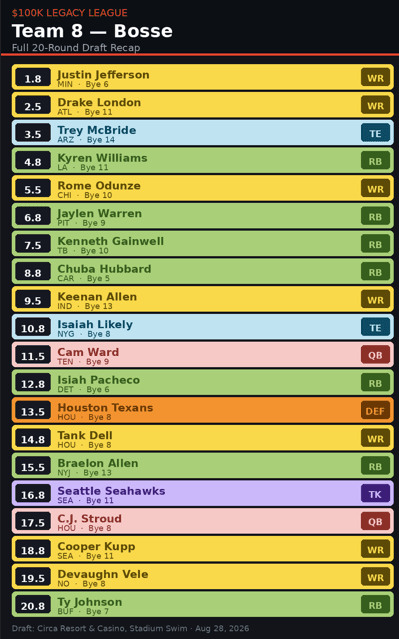
I love the start with three possible 100+ catch receiving options, but it also requires getting out at the running back position and holding enough edges at other positions to deliver a winning season. Rome Odunze has the talent and opportunity to offer a WR3 and a top-12 ceiling if his catch rate improves.
Kyren Williams fits the steady running back category, and Jaylen Warren has a high enough pass-catching floor to deliver an RB2 season if touchdowns come along for the ride. Last year, the Steelers’ backs ranked fifth in running back PPR scoring. Kenneth Gainwell and Chuba Hubbard have the feel of starting week-to-week players without an injury to each team’s lead back. Both could be serviceable for bye weeks, but are inconsistent flex options. The rest of Team 7’s running back depth doesn’t fit what I’m looking for (possible future starters or offering pass-catching value).
Unfortunately, the drafter came up short in wide receiver depth. Keenan Allen falls into a cloudy pass-catching situation, and his status took a hit this weekend due to an off-the-field issue. Tank Dell is on the shelf for at least six games, and Cooper Kupp lost his fantasy luster a couple of years ago.
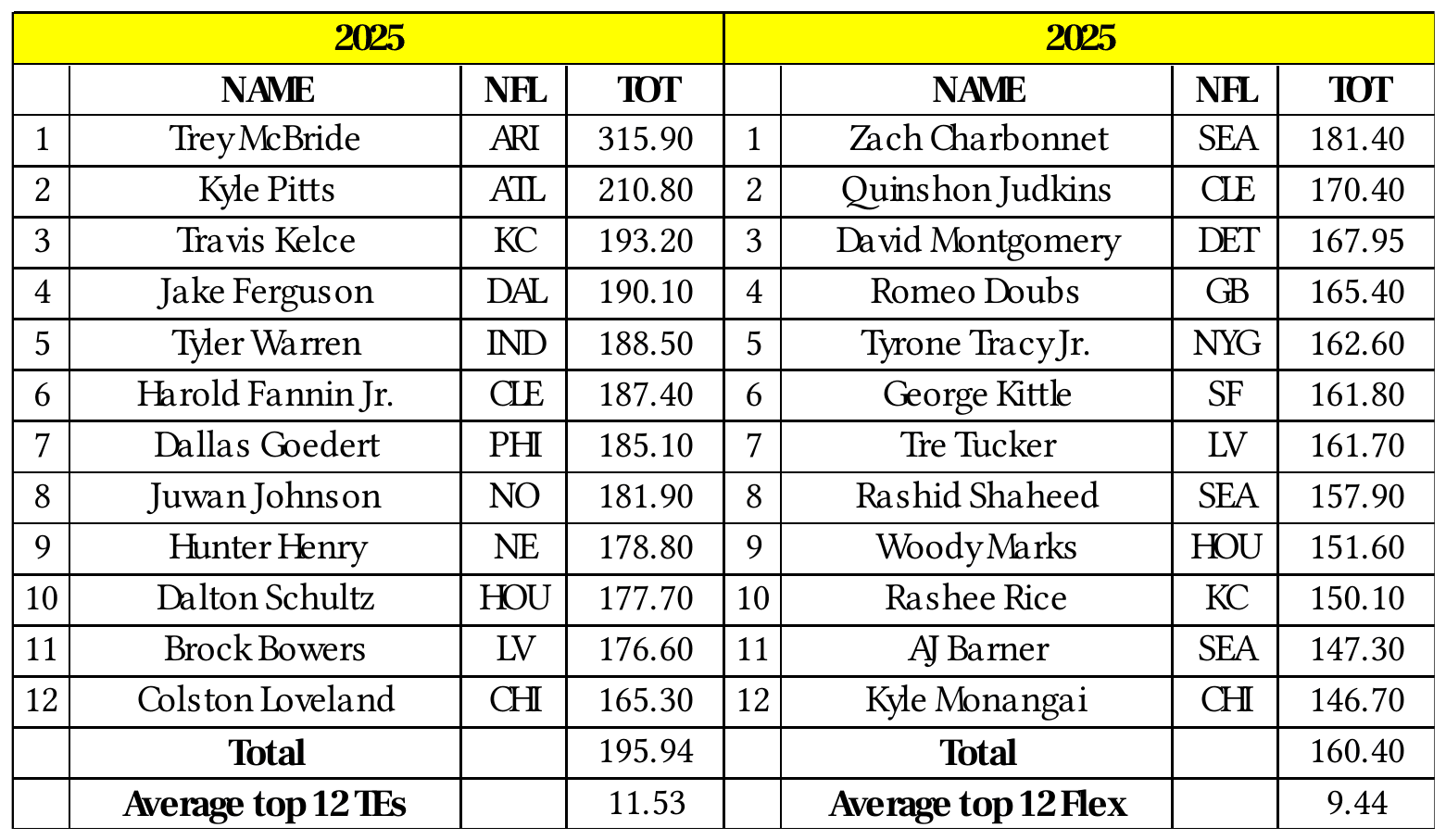
Isaiah Likely is a well-liked value/potential breakout tight end due to his former ties to the Giants’ new coaching staff. To be a viable flex option/edge, he must score over 180.00 PPR fantasy points.
The donation flag rose to the top of the fantasy flagpole in round 11, when Team 8 selected Cam Ward over Brock Purdy, Jared Goff, Bo Nix, Jalen Hurts, Jaxson Dart, Patrick Mahomes, and Baker Mayfield. I understand that he is the owner of the Titans (not really), but a drafter at this entry-fee level has to understand draft flow and player rankings, which are easily viewable at the National Fantasy Football Championship.
His backup quarterback (C.J. Stroud) has yet to reach starting top-10 fantasy status three years into his career, but he looked the part of an upside player across 15 games in his rookie campaign (21.81 fantasy points per game).
Does Cam Ward crush his winning chances? No, but drafting him as his QB2 would have been a much wiser decision. The Kruse brothers have made a living cheating the quarterback position and their wives (not), but they load up on running back and wide receiver depth, a luxury this team doesn’t have.
In this draft, Jacoby Brissett went undrafted. He scored over 20.00 fantasy points in nine of his 12 starts, thanks to averaging 40.3 passes per game (26.09 NFFC fantasy points per game). Your team already has Trey McBride, and Arizona has two talented wideouts. The next step is understanding his price point to buy before Week 1 of the season (don’t spend a bunch of money for an undrafted quarterback).
Your second waiver wire goal is improving your running back and wide receiver depth.
In the end, the bye-week swim and finding injury coverage at wide receiver look challenging. I see seven competitive pieces to your potential starting roster, which is at least three short of competing. I hope to see Brissett on your team in Week 1 because he makes the most sense. Kalshi has posted long odds here, but a league win would be such a great story.
Team 9
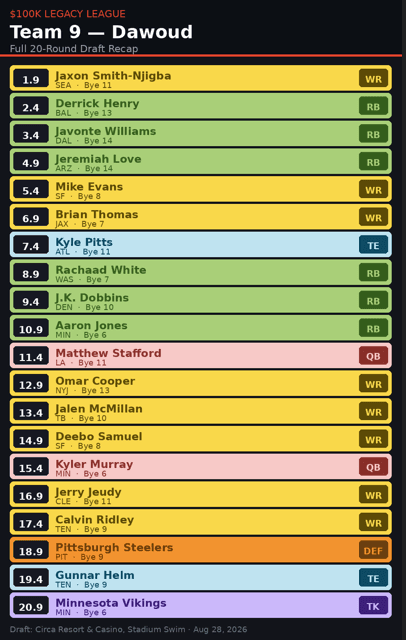
Jaxon Smith-Njigba was so good last year that he feels like a gift at pick 9. This drafter put together three competitive starting running backs (Derrick Henry, Javonte Williams, and Jeremiyah Love). Two of these options are relying on touchdowns to help with week-to-week consistency. Love fits the breakout stud category, as long as his ankle issue is minor.
Both Mike Evans (injury news) and Brian Thomas (sophomore slump) come into this year with different question marks, but both players have high upside in scoring and big-play potential. Kyle Pitts reached a much higher fantasy ceiling last year, which his rookie pedigree supported.
Team 9 will have an awakening once they go to set their lineup in Week 1. The NFFC doesn’t have two starting flex spots, something that is much needed in my opinion. Selecting three consecutive running backs from rounds 8 to 10 leaves this team short in the playable starting wide receiver depth department. Based on this, I sense that this drafter thought he could start four running backs.
Looking back at the draft, Xavier Worthy would have been my top choice in the 8th round at wide receiver, while Wan’Dale Robinson or Jordan Addison would have presented themselves in round 9. One wideout and two backs over three RBs may have been a significant upgrade to this roster.
His running back shove led to a wide receiver draft feast over the final 10 rounds at wide receiver (Omar Cooper, Jalen McMillan, Deebo Samuel, Jerry Jeudy, and Calvin Ridley). All wideouts selected check the reason box to be added to the back end of a fantasy roster, even if many drafters don’t agree. If this game manager can piecemeal their wide receivers through bye weeks and, hopefully, minor injuries, this roster should be better than it appears.
I have Matthew Stafford in my fade category due to his age, and I suspect 2026 may not go as well offensively for the Rams due to injuries, which is the nature of the game called fantasy football. His ADP does fall in the free zone, so any downside risk is removed by his price point and drafters' ability to secure a second competitive quarterback. I have Kyler Murray in the value category, making him an upside QB2 this year.
Team 9 has a balance of upside and consistency, with some injury risk. If his top seven players reach their potential, the playoff pack will be in reach as the fantasy league turns to the home stretch. In the end, his bye week covers and team managing will determine the ceiling of this roster.
Team 10
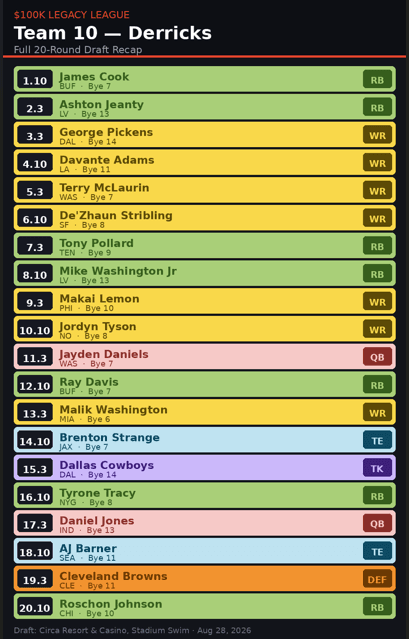
With double potential running backs (James Cook and Ashton Jeanty) in the house, Team 10 took no chances by securing both handcuffs. He added a third running back option in round 7 (Tony Pollard), but I wish he had handcuffed him with Nicholas Singleton. The Titans’ rookie running back is my Deep Sleeper Breakout Player of the Year. Pollard has gained over 1,000 rushing yards in four consecutive seasons with value in the passing game. His only resume shortfall has been scoring touchdowns in Tennessee.
His front three wide receivers (George Pickens, Davante Adams, and Terry McLaurin) each have the profile to fill WR1, WR2, and WR3 boxes with healthy years. Unfortunately, I’m not buying De’Zhaun Stribling at his current price point. He checks the upside and high ceiling categories, but where does he rank in the receiving food chain in San Francisco?
Christian McCaffrey, Mike Evans, and George Kittle will command a lot of balls. How does Deebo Samuel’s experience with the 49ers hurt their new hot-shot rookie wideout? If Evans has an injury, Stribling could then move into the fantasy gold category if his summer hype holds true.
His wide receiver depth (Makai Lemon and Jordyn Tyson) offers upside, but Tyson will miss some time.
For me, his tight ends (Brenton Strange and AJ Barner) don’t move the needle in the difference-maker category. Strange will catch some balls, but his touchdown upside is minimal, especially with the Jaguars having so much talent at wide receiver. The addition of Brandon Aubrey gained back some lost fantasy points, and he is the type of kicker who puts touchdowns through the uprights in the form of fantasy points.
Over the past few weeks, Jayden Daniels has started to free-fall in drafts due to potential offensive line issues. Running quarterbacks score well in the run game in the fantasy market, and the Commanders’ star quarterback brings an “it factor.” Daniel Jones helped the Colts’ offense move to an elite level over the opening half of 2025, and he didn’t run as much as expected.
This team must get elite scoring from Jeanty or some combination of him and Mike Washington. The flex position looks full of decisions, with Stribling’s success driving the upside bus. Team 10 must get some help off the waiver wire, micromanage his defenses, and make some winning lineup calls to reach the fantasy postseason.
Team 11
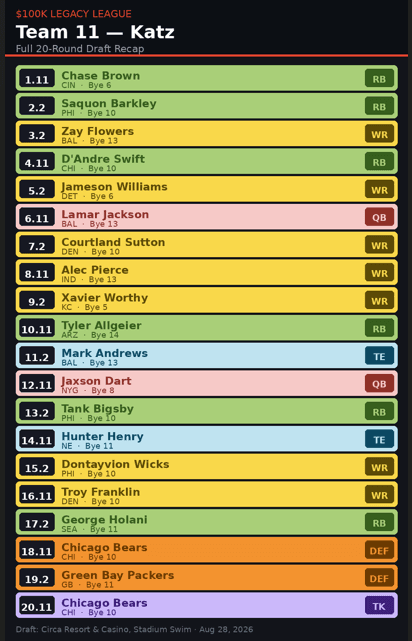
Winning in fantasy football is greatly helped by impact games that are often connected to scoring touchdowns and big plays. He has three wide receivers that fit explosive mode in yards (Jameson Williams, Alec Pierce, and Xavier Worthy). Pierce comes into Week 1 with an injury tag next to his name, while Worthy has a lot to prove after a down season tied to a shoulder injury.
Zay Flowers earns extra points for his consistency factor, but high scoring has been on his resume so far in his career. Williams is a must-start despite empty games being part of his NFL profile. Courtland Sutton finished with WR2 status over the past two seasons, but Jaylen Waddle will knock him down a notch in targets.
The WR3 position and flex position invite many decisions that ultimately can lead to missed points. Over the past week, D’Andre Swift gained momentum in drafts due to Kyle Monangai battling a knee issue, supporting him being worthy of a top-40 skill player (RB, WR, or TE) in PPR formats.
Chase Brown and Saquon Barkley have the talent to be 300.00 PPR fantasy players if they can score close to a dozen times each, which is needed to compete for a playoff spot.
Drafters continue to treat Lamar Jackson as a top-five quarterback despite the Ravens appearing to have a weaker outlook in tight end production, which has been a key part of his career over the past few years. For Jackson to regain his passing ceiling, Baltimore must get an uptick in production at wide receiver while lacking a true WR1 with impact scoring upside. His rush floor remains reasonable, but Jackson has lost momentum in scoring on the ground. Upside player, but is he worth the draft premium off a down year?
Team 10 placed more faith in the Ravens’ passing by securing Mark Andrews. A cleaner snap and target role suggests a rebound season, and touchdowns have been part of his best years. I like his wide receiver depth better than his late running back choices, but both could have minimal starting chances if his top draft choices stay healthy.
If Lamar finishes as a top-five quarterback, highlighted by a top-12 wide receiving year by Flowers (requires a minimum of seven TDs), and Andrews regains a bounce in his tight end step, this team has enough talent at running back and wide receiver to be competitive through bye weeks.
I also believe that Jaxson Dart has a legit chance to outpace Jackson in fantasy points if Malik Nabers (WR1 stud potential) plays well. He has a comparable tight end and has been willing to fight for rushing touchdowns. Dart’s biggest question is staying away from big hits.
There will be some challenges in decision-making, and one running back injury could be a severe downgrade to the ceiling of this roster.
Team 12
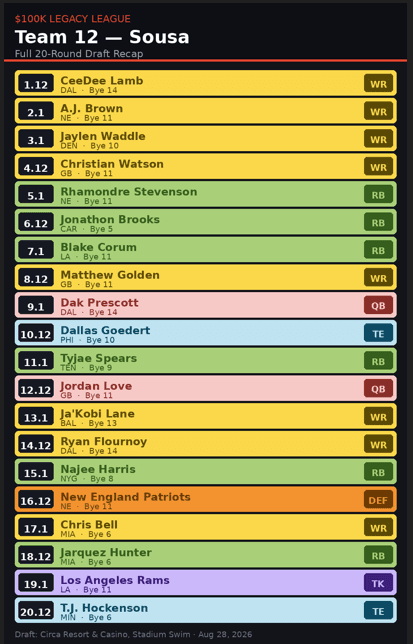
Team 12 opened his roster with two high-floor wideouts (CeeDee Lamb and A.J. Brown) who bring experience, success, and high-ceiling games to the table. Both players fit the profile of a foundation WR1. Lamb does have a much better WR2 competing for targets, but the Cowboys feature their wideouts in their passing game. The escape from Philly could lead to a significant uptick in targets for Brown, but it requires Drake Maye to air the ball out more in 2026 (502 pass attempts last season compared to 497 by the Eagles).
Jaylen Waddle feels like an advantage at WR3, and the fantasy market hasn’t seen his ceiling game since 2022 (75/1,356/8). The Broncos have depth at wide receiver, and they will throw to the running back position to move the chains. The attraction to Waddle in 2026 is his new offense, suggesting more value in the deep passing game.
Christian Watson checks the upside box, thanks to his ability to score and make big plays. Unfortunately, he’s missed 20 of his 68 possible starts over four seasons in the NFL. Fun WR4, but more of a gamble for the fantasy teams that line him up as WR2 with more strength at running back.
Rhamondre Stevenson was a big mover up the draft board in this league, but he wasn’t going to make it to the 6/7 turn. This drafter has TreVeyon Henderson in the fade column, which means that Stevenson is New England’s RB1 on the cheat sheet. I don’t agree, but it’s not my dime invested in this league.
Jonathon Brooks is a complete wild card due to his two missed seasons and no proof of life in his fantasy profile. He looks like a swing-for-the-fences player, but that could turn out to be a dribble to the pitcher. Blake Corum is the first upside handcuff selected in most of these high-stakes leagues. He’ll get on the field, but he lacks a high enough pass-catching profile to be trusted as a starting RB2 or flex option without a starting job.
Both Matthew Golden and Ja’Kobi Lane have upside, with the Packers’ second-year player providing handcuff value to Christian Watson. I expect Tyjae Spears to be a donation pick. He lost momentum in yards per rush (3.9) and yards per catch (5.9) last year, and Nicholas Singleton has the skill set to steal his role.
Team 10 paired Dak Prescott with Lamb and added the Cowboys' WR3. On the 14th/15th turn, I would have taken the kicking edge with Brandon Aubrey, even with a heavy investment in Dallas’ passing game. There are many other kickers with big legs, but securing one isn’t a lock.
Green Bay plays the Buffalo Bills at home in Week 14, with an opening over/under of 49.5 (tied for highest on the board), which is Team 12’s attraction to Jordan Love. He also has two of their wideouts.
Najee Harris looks viable to cover bye weeks if the Giants give him 175 touches this year. His NFL resume is high enough to outperform his current price point.
His tight end decisions (Dallas Goedert and T.J. Hockenson) are reasonable considering how long he waited at the position. Goedert scored 11 times last season, which doesn’t look repeatable. I have Hockenson as the deep value at tight end based on his body of work over the past few seasons.
Unfortunately, I don’t see a back on the roster with the opportunity to be a top-15 player unless Kyren Williams has an injury. If a free-agent starting running back presents itself, this team will shove to roster him. I think this team is a player short of contending, and bye-week decisions at wide receiver could be aggravating. His top three wideouts need to be beasts to help their chances.
Take the rankings with you — the free 2026 fantasy football cheat sheet
Want everything now? Get lifetime access
Shawn's Newsletter
Shawn publishes more like this on his Substack — waiver wires, bullpen reports, the full positional series.
Browse the newsletter feed →