
API & Data Licensing
Stop Building Sports Projections From Scratch. Plug Into Sportshack.
Sportshack gives sports apps, media companies, fantasy platforms and research teams access to quant probabilities—and a path to license Shawn Childs’ expert projections.

By J. Grant · updated September 9, 2026
Sports platforms do not win by displaying the same stats everyone else already has. They win by helping users decide what those stats mean.
That is why Sportshack.ai is making its projection infrastructure available to other providers.
Fantasy apps, sports media companies, research teams, newsletters, communities and emerging sports-tech products can use Sportshack data to power sharper rankings, comparisons, alerts, content and decision-support tools—without spending years building and maintaining an entire projection operation from zero.
The opportunity is bigger than a standard data feed. Sportshack brings together two distinct ways of seeing the game:
Most providers can offer one or the other. Sportshack can help partners put both to work.
The Quant API: probabilities with a paper trail
The Sportshack Quant Partner API provides read-only access to issued sports probabilities. But the probability is only the beginning.
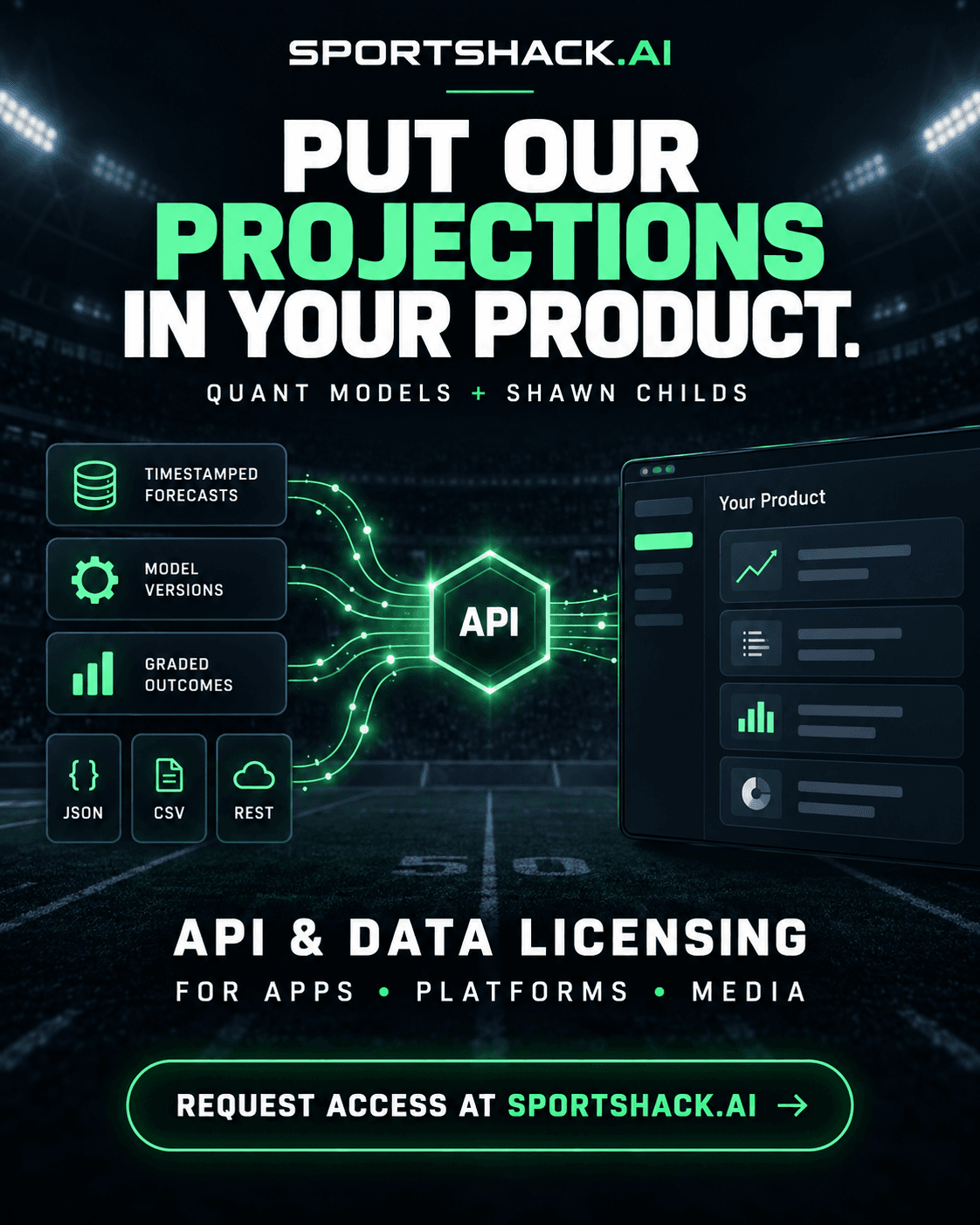
Each forecast is connected to its model version, issuance timestamp, contract semantics and provenance. Once an outcome is official, the result and grade remain attached to the forecast. Wins do not appear without the misses.
Partners can access:
This is data designed to be evaluated, audited and used—not a screenshot of a pick with no record of when it changed or how it performed.
The API does not place wagers, route orders or hold funds. It also does not redistribute venue prices, order books, bids, asks, liquidity or other licensed market data. Sportshack supplies its own analytical output and the evidence attached to it.
The Shawn Childs layer: projections with football judgment behind them
Models are powerful. So is knowing when the numbers need context.
Shawn Childs has spent decades building fantasy football projections from the team level down: offensive expectations, player opportunity, role, depth-chart movement, injuries, scoring environment and the way every share of an offense must fit together.
His 2026 NFL Fantasy Guide spans all 32 teams, approximately 146,000 words and 360 player writeups. The projections are not detached numbers; there is an analyst’s reasoning behind the workload, ranking and outlook.
That system is also tested in public. Sportshack’s 2025 retrospective backtest covers 3,955 player-weeks and reports a 0.1367 Brier score with 0.218 skill versus the base-rate benchmark. Partners and users can inspect the methodology and the result rather than relying on a vague accuracy claim.
For providers seeking a differentiated fantasy product, Sportshack can scope a commercial data license or custom feed around Shawn’s projections, rankings and related output. Partners interested in both analyst and quantitative data can discuss an integration matched to their product and publishing rights.
What can a partner build with Sportshack data?
The same projection layer can support very different products:
The goal is not to force every partner into the same interface. It is to supply reliable projection inputs that can live inside the product your audience already uses.
Built for providers, not just page views
Sportshack was built around a straightforward belief: a forecast should be timestamped before the event, preserved after publication and graded when reality arrives.
That discipline matters even more when projections power someone else’s product. Providers need to know which version they received, when it was issued, what it referred to and whether the historical record includes every result.
The Quant API is available through monthly or seasonal internal-use licenses. Publication, redistribution and resale rights require a separate publisher agreement. Shawn Childs projection licensing and combined-data implementations are scoped directly with each partner.
Tell us what you are building
If you operate a fantasy app, content network, analytics platform, sports community, voice product or research workflow, Sportshack wants to hear the use case.
Request Sportshack API access and include your company, intended use, preferred term, expected volume and whether you are interested in quant forecasts, Shawn Childs’ projections or both.
You bring the audience and the product. Sportshack brings projections built to plug in.
Take the rankings with you — the free 2026 fantasy football cheat sheet
Want everything now? Get lifetime access