
Analysis
The Seven NFL Signals I’m Tracking Every Week in 2026
Play callers, participation, routes, pace, red-zone work, family-specific defense, and model-versus-market disagreement form the weekly update loop.

By J. Grant · updated August 27, 2026
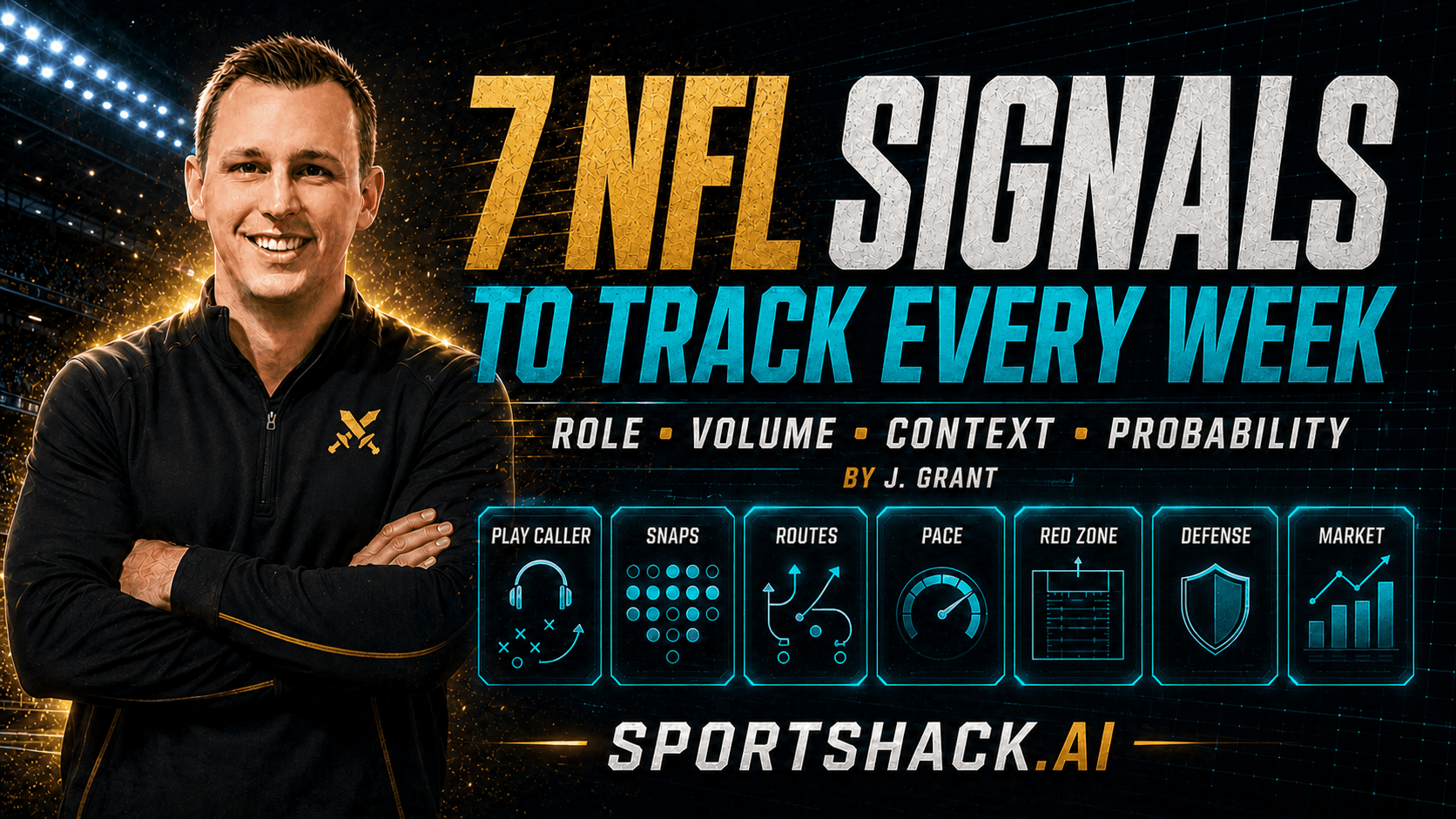
The first set of NFL projections is never the final answer.
The preseason model establishes team scoring, expected plays, run/pass mix, depth charts, and player opportunity. Once the season begins, every game gives me new information. The challenge is deciding which changes are meaningful and which ones are one-week noise.
A player can score twice on six touches. A wide receiver can lead his team in targets because another starter left early. A defense can rank last against the pass after facing two elite quarterbacks. A new coordinator can call the same offense as the coach before him—or change the identity of the team in one week.
The weekly process has to be organized. These are the seven signals I want dated, measured, and attached to every 2026 projection update.
1. The Actual Play Caller
The head coach, offensive coordinator, and person calling plays are not always the same.
My 2026 coaching file tracks all 32 teams with dated records. The offensive play caller is reported for every team. On defense, 19 callers are reported directly and 13 use the coordinator as the inferred default.
That distinction stays visible. If the direct caller is unknown, I will use the coordinator as the working assumption and label it `INFERRED`. I will not turn an assumption into a reported fact.
The play caller influences pace, early-down passing, formation, motion, red-zone design, and which players receive manufactured touches. If a coach is fired, retires, or hands off duties, the previous record stays intact and a new dated regime begins.
Get the free 2026 fantasy football cheat sheet
Want everything now? Get lifetime access
2. Participation Before Production
Fantasy points tell me what happened. Participation helps explain why.
I want to know:
A running back can score 18 fantasy points on 35% of the snaps and still have a fragile role. Another back can score nine points on 75% of the snaps and remain the better projection the following week.
The same discipline applies to zeroes. A player who did not dress is not a projection miss. A player who dressed but never entered the game is not the same as a starter who ran 30 routes without a target. DNP, inactive, partial-game, and played-with-zero-stat outcomes need separate labels.
3. Routes, Targets, and the Shape of the Passing Game
Targets are valuable, but they become more useful when tied to routes and depth of target.
A receiver with eight targets on 38 routes owns a different opportunity than a receiver with eight targets on 20 routes. Short targets can create a reception floor without producing the same yardage ceiling. Deep targets create more variance and can make the player's average look ordinary until the explosive plays arrive.
I also want to know where the targets came from:
This information helps separate the reception projection from the receiving-yard projection. The 2025 defense test supported that distinction: receptions earned a small matchup adjustment, while receiving yards did not.
4. Pace, Plays, and Neutral-Situation Intent
Volume remains the engine of fantasy production.
Raw pass attempts can be misleading after one game. A team may throw 45 times because it trailed by three touchdowns. I care more about what the offense did before the score forced its hand.
Each week I want to update:
A faster game can create extra opportunity for both teams. A slow offense with a strong defense can lower the number of possessions even when its players are efficient.
The team projection has to move before I redistribute the player shares.
5. Red-Zone and Goal-Line Opportunity
Touchdowns create the biggest weekly swings, but last week's touchdown total is usually a poor projection by itself.
I want the opportunities behind the scores:
A player with four red-zone opportunities and zero touchdowns may be a stronger future scoring candidate than a player who scored twice on two opportunities.
This is also where coaching and defense interact. The 2025 research found that a conservative defensive adjustment helped passing-touchdown probabilities. It did not justify moving every yardage or touchdown family.
6. Defense by Statistic, Not One Overall Ranking
I do not want one defense-versus-position number controlling the entire player projection.
The 2025 holdout test supported a 25% matchup adjustment for passing touchdowns and receptions. Passing yards, receiving yards, rushing volume, interceptions, and the other tested families remained at zero.
That is how I will begin 2026: use the features that earned a role and leave the others available for study.
As the season develops, the defensive file should account for:
September samples require extra shrinkage. One unusual game cannot become the entire defensive identity.
7. Model Versus Market Disagreement
The market provides another reference point, but it is not an answer key.
For an exact player, game, statistic, and threshold, I want to compare the frozen Sportshack probability with a current fair market probability. The gap helps identify which projections deserve another review.
It can expose:
The comparison must use the exact contract. Missing, stale, one-sided, or unparseable market data remains unavailable. It never becomes zero.
The market can cause me to inspect a projection. It cannot cause me to rewrite a frozen issued forecast after the fact.
How the Seven Signals Work Together
No single input should move a projection without the rest of the football story.
Suppose a receiver's targets rise. I want to know whether his routes increased, whether the offense played faster, whether another receiver was injured, and whether the new play caller changed the formation. If the targets rose on the same role because the team trailed all afternoon, the next-week adjustment may be small. If the player became a full-time starter and earned first-read targets, the move should be larger.
The weekly sequence should be:
1. Confirm coaching and injury changes.
2. Classify participation accurately.
3. Update team plays and scoring.
4. Reassign player opportunities.
5. Apply only approved family-specific matchup adjustments.
6. Convert the point projections into threshold probabilities.
7. Compare exact contracts with the current fair market and investigate the largest disagreements.
8. Freeze the weekly version before the event and grade it afterward.
In the end, I am trying to avoid two mistakes: reacting too slowly when a role really changes and reacting too aggressively to one noisy result.
The data should make the football opinion more disciplined. The football opinion should keep the data from confusing an unusual game with a permanent trend.
That is the weekly work. Build the preseason foundation, date every change, and make each Sunday prove which adjustments deserve to survive for the rest of the season.
Research note: The coaching context described here is prospective for 2026. Historical 2023–25 play-caller regimes are not complete. Analytics only. No bet placement.
Take the rankings with you — the free 2026 fantasy football cheat sheet
Want everything now? Get lifetime access